< Back to blog
Blog/engineering

What Is a Full Stack Developer? Why Your Startup Needs One

What is a full stack developer and why does your startup need one? Plain-English explanation plus a breakdown of skills, cost, and how to hire right.

15 Mar 2026/10 min read
what is a full stack developerfull stack developer for startuphire full stack developer

Article

Clean hierarchy, tighter spacing, and readable markdown blocks across desktop and mobile.

10 minute read

TL;DR: A full stack developer builds everything — the frontend users see, the backend that powers it, and the database that stores it all. For startups with small teams and limited budgets, one great full stack developer can replace the need for three separate specialists. This post explains exactly what the role involves, what to look for, and why it matters more than most founders realise.

If you have been researching how to build your startup's product, you have probably encountered the phrase "full stack developer" and wondered whether you need one. Maybe you have seen job listings with long lists of technologies and wondered what any of it actually means.

This post is the plain-English answer. By the end of it, you will know exactly what a full stack developer does, whether your startup needs one, and how to evaluate candidates properly.


The Simple Explanation

A website or web application has two main parts.

The frontend is everything a user sees and interacts with. The buttons, the forms, the pages, the animations. This is built with HTML, CSS, and JavaScript. In 2025, it is most often built with frameworks like React, Next.js, or Vue.js.

The backend is the engine running behind the scenes. When you fill in a form, the backend processes it. When you check your order status, the backend retrieves it from a database. When you log in, the backend verifies your credentials. This is built with server-side languages and frameworks — Node.js, Python, Ruby on Rails, PHP, and others.

The database stores everything permanently — user accounts, products, orders, content. Common databases include PostgreSQL, MySQL, and MongoDB.

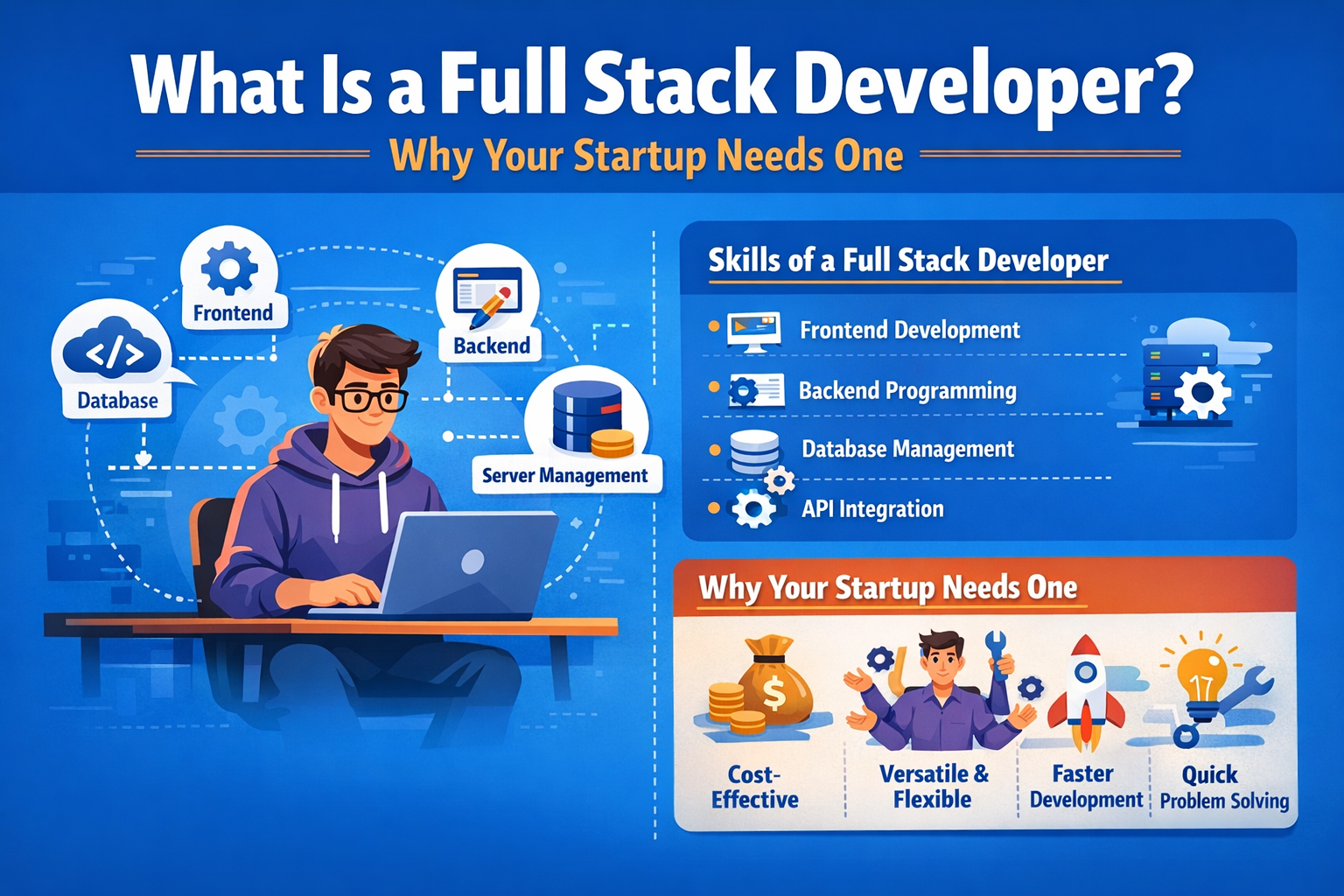
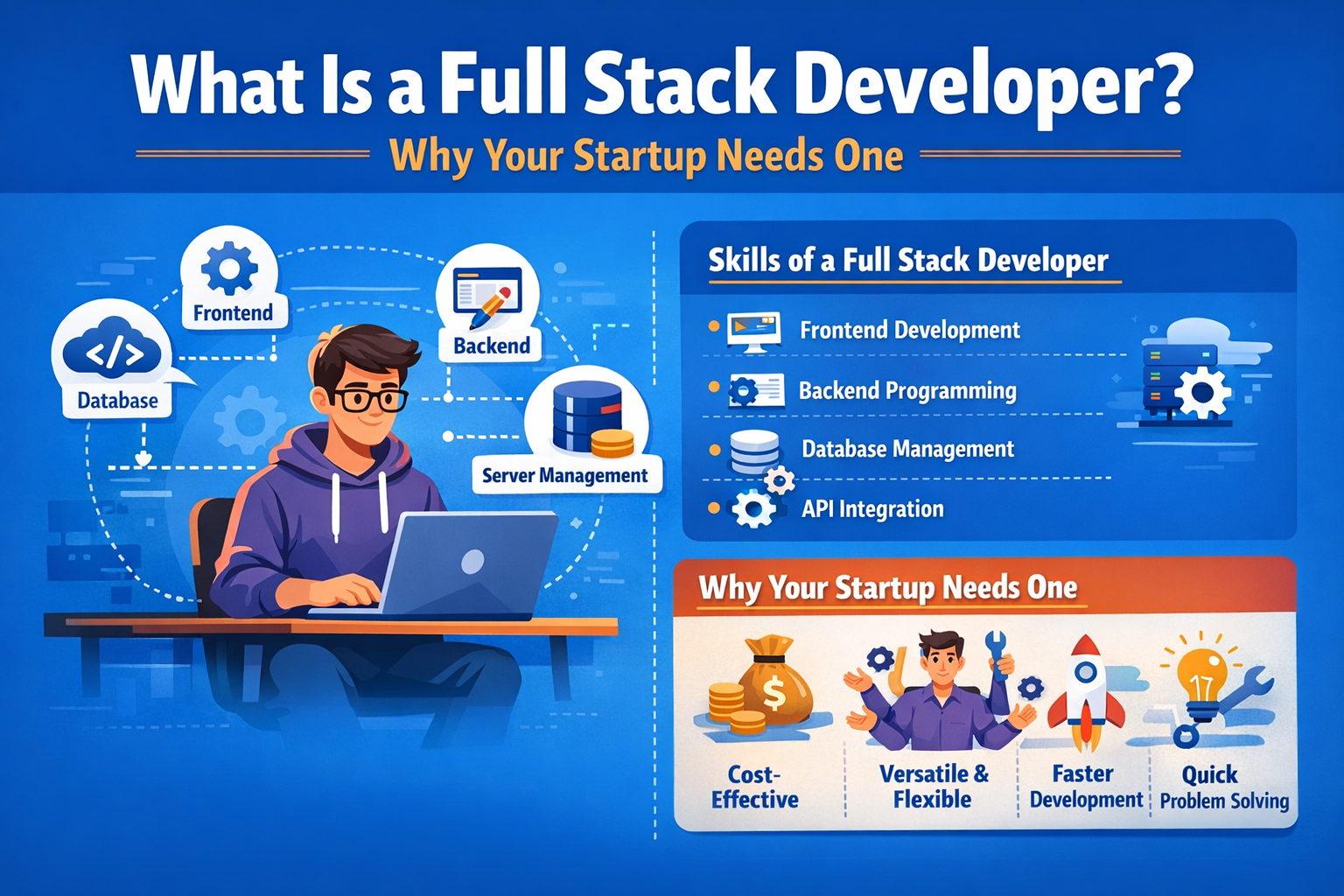
A full stack developer is someone who can build all three layers. They are not a specialist in just one. They can design the database, write the backend API, build the frontend interface, and deploy the whole thing to production.


What "Stack" Actually Means

The word "stack" refers to the collection of technologies used to build a web application — the layers stacked on top of each other to create a complete product.

A common modern stack in 2025 looks like this:

LayerTechnology
Frontend frameworkNext.js / React
StylingTailwind CSS
Backend / APINode.js with Express or Next.js API routes
DatabasePostgreSQL via Supabase
AuthenticationSupabase Auth / NextAuth
DeploymentVercel
LanguageTypeScript throughout

This is the T3 Stack or a Supabase-powered Next.js stack — the dominant choice for modern full stack development. Dipanshu Kumar Pandey at dipanshudev.com uses exactly this stack, which allows a single developer to ship complete products quickly without needing a separate backend team.


Frontend vs Backend vs Full Stack: Key Differences

Frontend Developer

  • Builds user interfaces
  • Works with HTML, CSS, JavaScript, and frameworks like React
  • Focuses on visual design implementation, responsiveness, and user experience
  • Does not typically build APIs or manage databases

Backend Developer

  • Builds server-side logic
  • Writes APIs that the frontend calls
  • Manages databases, authentication, and business logic
  • Does not typically build user interfaces

Full Stack Developer

  • Does all of the above
  • Can architect the entire application
  • Can deploy and manage hosting infrastructure
  • Often the most valuable hire for early-stage startups

DevOps / Infrastructure Engineer

  • Manages cloud infrastructure (AWS, GCP, Azure)
  • Sets up CI/CD pipelines, monitoring, scaling
  • Usually a separate role at larger companies
  • Many senior full stack developers handle basic DevOps themselves

What a Full Stack Developer Does Day-to-Day

Here is a realistic picture of what a full stack developer actually works on:

Week 1 of a new project:

  • Set up the project repository and development environment
  • Design the database schema (what tables/collections are needed, how they relate)
  • Set up authentication (user registration, login, password reset)
  • Build the basic API routes (CRUD operations for core data)

Weeks 2–4:

  • Build the frontend pages and components
  • Connect frontend to backend APIs
  • Implement business logic (checkout flow, notifications, user permissions)
  • Add form validation on both frontend and backend
  • Write basic tests

Before launch:

  • Set up deployment pipeline
  • Configure environment variables and secrets
  • Optimise for performance (image compression, code splitting, caching)
  • Implement Technical SEO (meta tags, sitemap, structured data)
  • Set up error monitoring (Sentry) and analytics (GA4)

Post-launch:

  • Fix bugs reported by users
  • Add features based on feedback
  • Monitor performance and uptime
  • Update dependencies and patch security issues

The Technologies a Full Stack Developer Should Know in 2025

This is not an exhaustive list, but these are the core skills that signal a competent full stack developer:

Frontend

  • React or Next.js (essential)
  • TypeScript (near-essential for serious projects)
  • Tailwind CSS or styled-components
  • State management (Zustand, Redux, or React Query)
  • Responsive design and mobile-first CSS

Backend

  • Node.js with Express, Fastify, or Next.js API routes
  • REST API design principles
  • GraphQL (bonus)
  • Authentication (JWT, OAuth, sessions)
  • File uploads and storage (AWS S3, Cloudflare R2)

Database

  • SQL fundamentals (SELECT, JOIN, transactions)
  • PostgreSQL (widely used in production)
  • An ORM or query builder (Prisma, Drizzle)
  • Basic understanding of indexing and query performance

Infrastructure

  • Git and GitHub (essential)
  • Deployment on Vercel, Railway, or Render
  • Basic Linux command line
  • Environment variables and secrets management
  • Understanding of DNS and domains

Bonus Skills (that separate good from great)

  • Technical SEO (meta tags, Core Web Vitals, structured data)
  • Performance optimisation (Lighthouse, WebPageTest)
  • Security basics (SQL injection, XSS, CSRF)
  • Docker (for containerised deployments)

Why Startups Specifically Need Full Stack Developers

1. Speed Over Specialisation

At the startup stage, speed to market beats perfection. A full stack developer can move a feature from idea to production without handoffs between a frontend team, backend team, and infrastructure team. No waiting for another person to finish their piece before you can start yours.

In a two-person startup, a full stack developer is the entire engineering department.

2. Cost Efficiency

Hiring three specialists — a frontend developer, a backend developer, and a DevOps engineer — costs 3x as much as hiring one senior full stack developer. For a startup with limited runway, this difference is not marginal. It is existential.

A full stack developer at $60/hour replacing three specialists at $60/hour each represents a $240,000 annual saving at full-time rates. That runway can fund 18 months of marketing, a second hire, or simply the time needed to achieve product-market fit.

3. Unified Vision

When one person builds the whole product, there is no blame-shifting between teams. The frontend developer cannot say "that is a backend problem." There are no integration bugs caused by two teams making different assumptions about the API contract.

One developer, one codebase, one accountable person.

4. Communication Efficiency

Every additional person in a software project adds communication overhead. Standup meetings, Slack threads, pull request reviews across teams, disagreements about architecture. A full stack developer eliminates most of this at the early stage.


When You Need Specialists Instead

Full stack developers are not always the answer. Here is when you genuinely need specialists:

When your product has a complex ML/AI core. A full stack developer who dabbles in machine learning is not the same as a data scientist who specialises in it. If ML is your product, hire a specialist.

When you are scaling an engineering team. At 20+ engineers, specialisation becomes necessary. Frontend and backend teams can work in parallel on larger features. A full stack approach does not scale infinitely.

When your product has specific expertise requirements. A payments platform needs backend developers who specialise in financial systems. A graphics-heavy product needs frontend engineers who specialise in WebGL or Canvas.

When your current full stack developer is the bottleneck. This is actually a success problem. If one person cannot keep up with the workload, you have validated your product enough to hire specialists.


How to Evaluate a Full Stack Developer (Without Being Technical Yourself)

If you are a non-technical founder hiring a full stack developer, these questions will tell you a lot:

Portfolio Questions

  1. "Walk me through a project you built — what did the user want to do, how did you design the database, and how did the frontend connect to the backend?"
  2. "What was the hardest bug you fixed in this project, and how did you diagnose it?"
  3. "Show me a live URL — not just a GitHub repo."

Depth Questions

  1. "If the API call is slow, where do you start looking?"
  2. "How do you handle authentication in your projects?"
  3. "What would happen to your app if the database went down? Have you thought about that?"

Process Questions

  1. "How do you handle scope changes after development starts?"
  2. "How do you communicate progress when you are stuck?"
  3. "What does your deployment process look like?"

Red Flag Answers

  • "I use a CMS for the backend" (they may not be a true full stack developer)
  • Long pause on any basic technical question that suggests they are guessing
  • No live portfolio — only code repos or screenshots
  • Inability to explain the system architecture of their own past projects

Full Stack Developer Rates in 2025

Rates vary significantly by geography and experience level:

Location / LevelHourly Rate (USD)
India, mid-level$25–$50/hr
India, senior$50–$90/hr
Eastern Europe, mid-level$40–$70/hr
UK, mid-level$60–$100/hr
US, mid-level$80–$150/hr
Senior full stack + SEO$60–$120/hr (India)

For UK and US startups, hiring a senior Indian full stack developer often delivers better value than hiring a mid-level local developer. The quality at the senior level is comparable, and the cost difference is substantial.


The Full Stack Developer + Technical SEO Combination

One thing that distinguishes the most valuable full stack developers for early-stage startups is whether they understand Technical SEO.

A developer who builds a website without SEO knowledge produces a functional product. A developer who builds a website with Technical SEO knowledge produces a product that ranks, attracts organic traffic, and grows without paid acquisition.

The difference includes:

  • Choosing SSG/SSR rendering instead of client-side rendering
  • Adding proper meta tags, canonical URLs, and Open Graph tags
  • Implementing structured data (JSON-LD schemas)
  • Optimising Core Web Vitals (LCP, CLS, INP)
  • Building proper URL structures from the start
  • Generating sitemaps and robots.txt automatically

At dipanshudev.com/services, this combination of full-stack development and Technical SEO is the core service offering — because it reflects what early-stage startups actually need to grow.

The AaoCollege EdTech platform is an example: full stack development with Technical SEO built in from day one resulted in 20% more organic leads. That outcome does not happen when SEO is an afterthought.


Full Stack Developer vs Generalist Agency: How to Choose

FactorFull Stack DeveloperWeb Agency
CostLowerHigher (agency margins)
CommunicationDirectVia account manager
AccountabilityClear (one person)Sometimes diffuse
SpeedFast for well-defined scopeSlower (process overhead)
ScalabilityLimited to one person's bandwidthCan scale resources
Quality consistencyDepends on individualDepends on agency
Best forMVPs, startups, specific product workBrand campaigns, large projects

For most early-stage startups working on a specific product or website, a senior full stack developer is the better choice over an agency.


Conclusion

A full stack developer is not just someone who knows a bit of everything. A great full stack developer is someone who can take a product from concept to production — architecting the data model, building the API, creating the frontend, deploying it, and making sure it performs and ranks.

For startups, this person is one of the most valuable people you can bring onto your project. They are the difference between three months of team coordination and three weeks of focused shipping.

If you are building a web product and have not started yet, this is the hire to make first.


Need this done properly

Build, performance, SEO, and content can be handled in one delivery flow.

If you are planning a business site, technical blog, or product build that needs to look sharp and rank cleanly, the same approach can be applied to your stack.

Keep reading

Related articles

More posts connected to the same delivery, SEO, or product engineering themes.

View all articles