


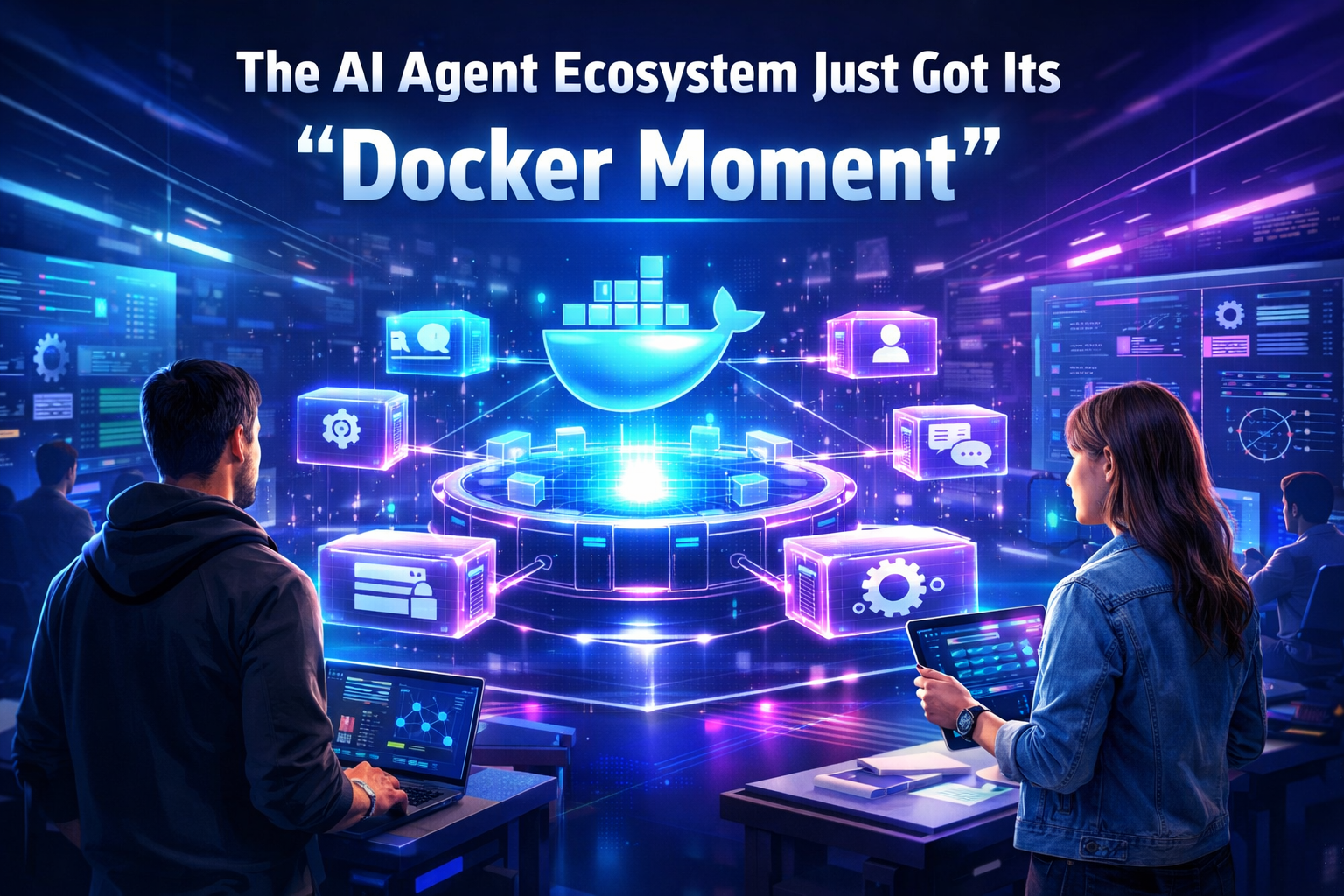
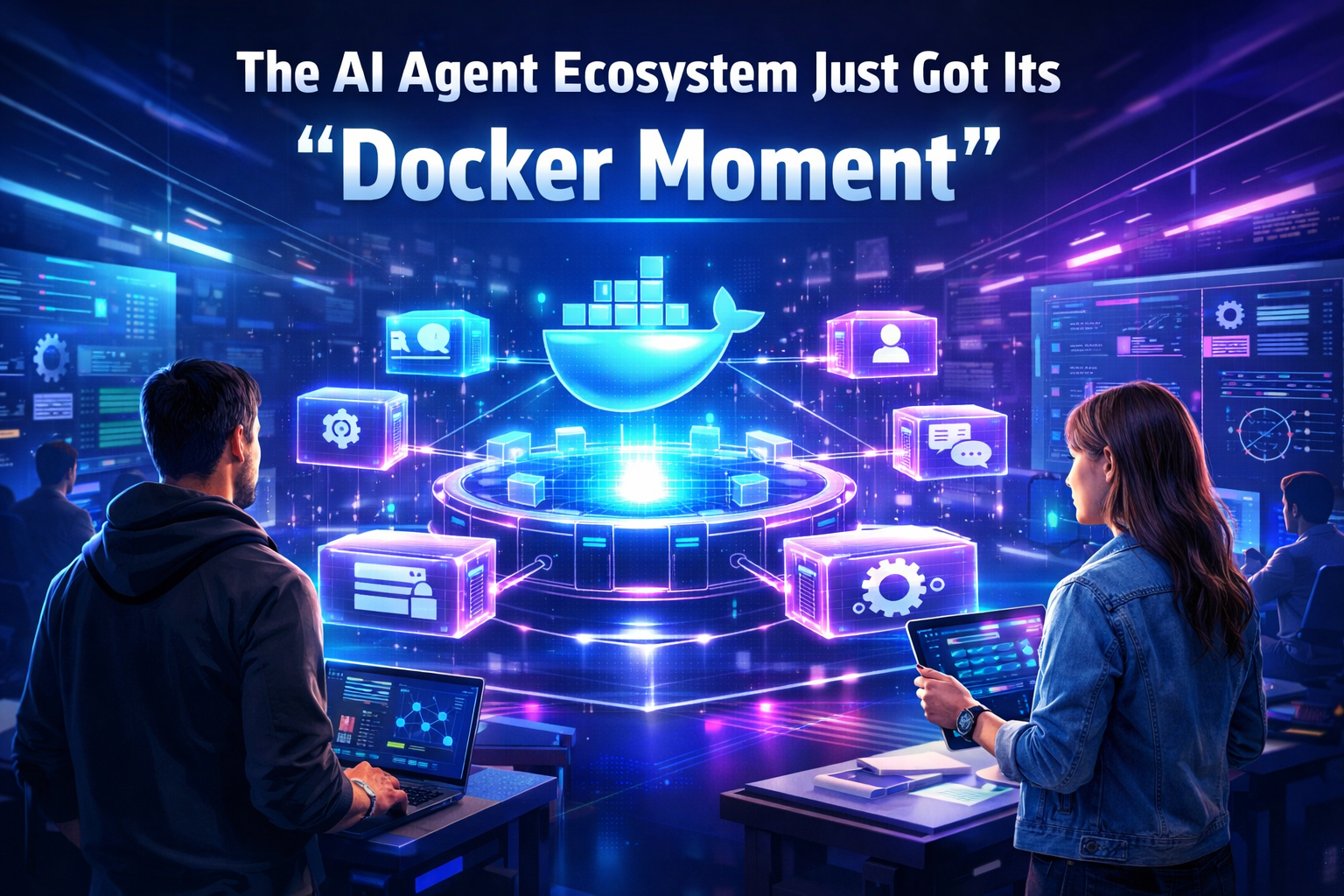
The AI agent ecosystem just got its "Docker moment."
The AI agent ecosystem is undergoing a major transformation—its “Docker moment.” As agents become modular, reusable, and orchestrated, developers can now build scalable AI systems just like modern software architectures. Here’s what it means for the future of AI.
Structured like an editorial page, with a cleaner reading flow instead of repeated card blocks.
Artificial Intelligence is evolving at an unprecedented pace. From rule-based systems to powerful large language models (LLMs), the journey has been remarkable. However, despite all the progress, building scalable AI systems has remained complex, fragmented, and difficult to manage.
Developers often deal with multiple APIs, disconnected workflows, and tools that don’t integrate well. Systems break, scaling becomes difficult, and maintaining consistency is a challenge.
But now, something fundamental is changing.
👉 The AI agent ecosystem is entering its “Docker moment.”
Just like Docker revolutionized software deployment by introducing containerization, AI agents are now becoming modular, reusable, and orchestrated systems—bringing structure, scalability, and standardization to AI development.
Article gallery
The AI agent ecosystem just got its "Docker moment." visuals from the admin gallery
🐳 Understanding Docker’s Moment
To understand this shift, we need to look back at what Docker did for software.
Before Docker:
- Applications were tightly coupled to environments
- Dependencies caused frequent failures
- Deployments were inconsistent across systems
- Developers often said, “It works on my machine”
After Docker:
- Applications became containerized
- Environments became portable and consistent
- Deployment became faster and more reliable
- Scaling systems became easier
👉 Docker didn’t just fix deployment—it transformed how software is built, shipped, and run.
🤖 What Are AI Agents?
AI agents are more than just chatbots or prompt-based systems. They are intelligent systems that can:
- Understand a goal
- Break it into steps
- Use tools and APIs
- Execute tasks autonomously
- Learn and improve responses
Unlike traditional AI systems that only respond to inputs, agents can take actions and complete workflows.
For example:
- A simple AI model answers a question
- An AI agent completes a task (like booking, searching, analyzing, etc.)
🔄 From Prompts to Intelligent Systems
Earlier AI usage was simple:
Prompt → Response
This worked for basic tasks, but it was limited.
Now, AI systems operate like this:
Goal → Planning → Execution → Validation → Output
This means multiple components working together:
- Planner agent
- Executor agent
- Validator agent
👉 This is the foundation of modern AI systems.
🧩 The New AI Stack
Modern AI architecture is no longer just about models. It is a complete system:
- 🧠 LLMs (GPT, Claude, etc.)
- 🔧 Tools (APIs, databases, search engines)
- 🤖 Agents (task handlers)
- 🔗 Orchestration layers (workflow managers)
Comparison with Software Evolution:
Old Software Architecture:
Need this done properly
Build, performance, SEO, and content can be handled in one delivery flow.
If you are planning a business site, technical blog, or product build that needs to look sharp and rank cleanly, the same approach can be applied to your stack.