


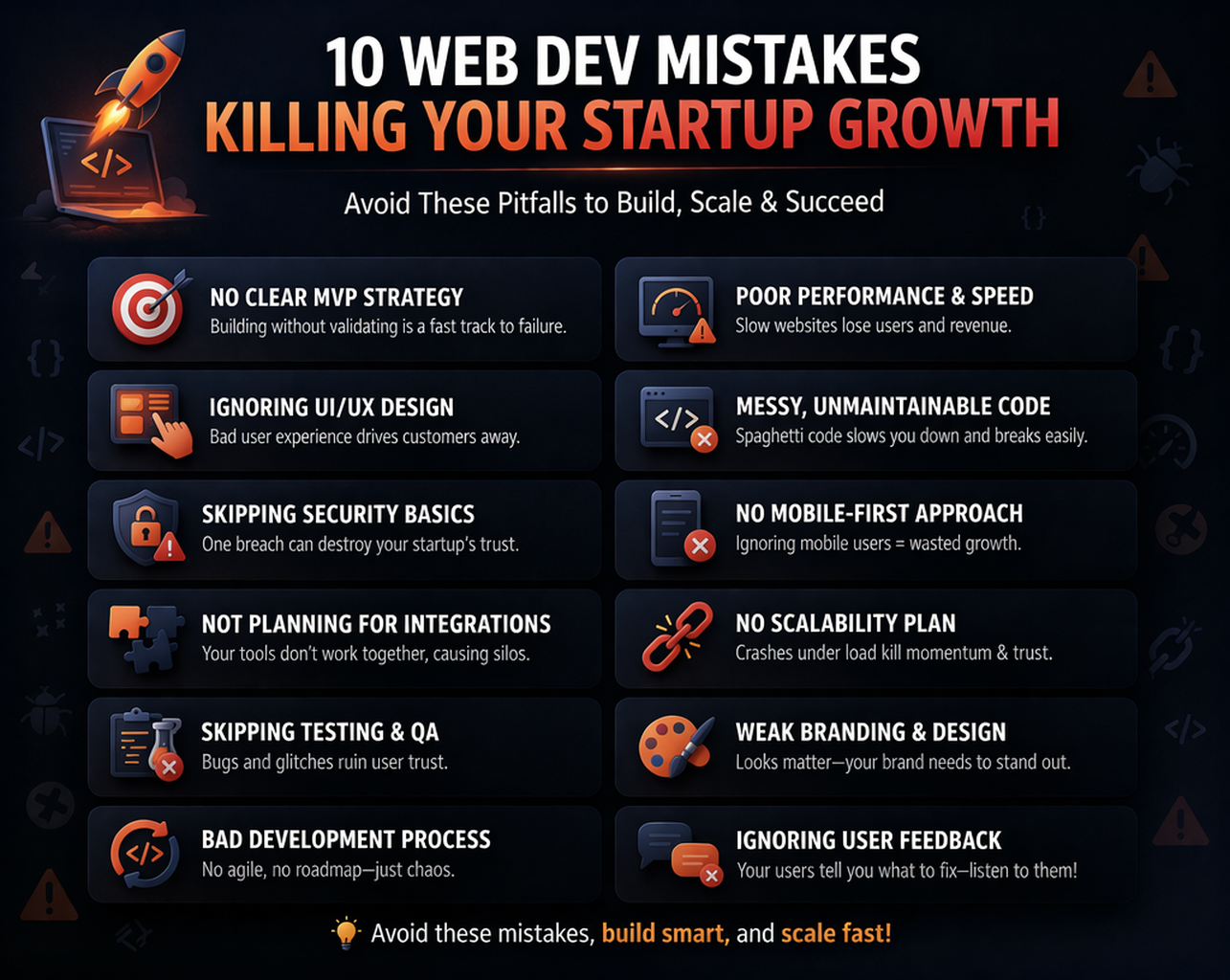
10 Web Dev Mistakes Killing Your Startup Growth
Avoid these 10 costly web development mistakes that quietly strangle startup growth. Real fixes, real numbers, and what to do instead.
Structured like an editorial page, with a cleaner reading flow instead of repeated card blocks.
In today’s fast-moving digital world, a website is not just a digital presence — it is the backbone of your startup’s growth. Whether you're building a SaaS product, a job portal like HHH Jobs, or an e-commerce platform, your website directly impacts user trust, conversions, and scalability. However, many startups unknowingly make critical web development mistakes that slow down their growth or even lead to failure. These mistakes are not always obvious, but their impact is massive. In this article, we will explore the top 10 web development mistakes that are killing startup growth — and how to fix them.
One of the biggest reasons startups fail to convert users is slow website performance. If your website takes more than 3 seconds to load, most users leave before even seeing your content. Slow performance affects user experience, SEO rankings, and conversion rates. This usually happens due to unoptimized images, heavy frontend bundles, and unnecessary API calls. The solution is to optimize images using modern formats like WebP, implement lazy loading, reduce JavaScript bundle size, and use a CDN. A fast website builds trust and improves engagement instantly.
Another major mistake is ignoring mobile users. Most traffic today comes from mobile devices, but many startups still design for desktop first. This leads to broken layouts, unreadable text, and buttons that don’t work properly. A poor mobile experience pushes users away quickly. To fix this, adopt a mobile-first design approach, use responsive frameworks like Tailwind CSS, and test your website on real devices to ensure consistency.
Poor UI/UX design is another silent growth killer. If users don’t understand what to do on your website, they will leave. Too many options, cluttered layouts, and lack of clear call-to-action buttons confuse users. A clean and simple design with proper spacing, readable fonts, and clear CTAs like “Apply Now” or “Get Started” can significantly improve user engagement and conversions. Always guide users step-by-step through your platform.
Weak backend architecture is a technical mistake that becomes dangerous as your startup grows. In the beginning, everything may work fine, but as users increase, a poorly structured backend leads to performance issues and bugs. Mixing logic, unorganized code, and lack of separation between components make the system hard to scale. The solution is to follow a proper architecture using routes, controllers, services, and models so that your system remains clean and scalable.
Ignoring security is one of the most critical mistakes. A single security issue can destroy your startup’s reputation. Common risks include data leaks, unauthorized access, and injection attacks. To prevent this, always use secure authentication methods like JWT, enforce HTTPS, validate user inputs, and store sensitive data in environment variables. Security should never be an afterthought.
Many startups also fail because they ignore SEO optimization. A beautiful website is useless if no one can find it. Missing meta tags, poor titles, and lack of proper structure make it difficult for search engines to rank your site. To solve this, add proper meta titles and descriptions, use clean URLs, create a sitemap, and connect your website to Google Search Console. SEO is a long-term growth driver that should be implemented from the beginning.
Over-engineering is another common mistake. Startups often try to build overly complex systems instead of focusing on solving the core problem. Using advanced architectures too early, adding unnecessary features, or integrating too many technologies slows down development and increases costs. The best approach is to start with a simple MVP, validate your idea, and then scale based on user feedback.
Skipping testing can lead to serious problems in production. Many developers assume everything works fine until users start reporting issues like forms not submitting, buttons not working, or pages breaking randomly. This damages user trust. To avoid this, use tools like Playwright for UI testing and Postman for API testing. Even basic testing can save your product from major failures.
Another mistake is not using analytics and tracking tools. Without data, you don’t know how users interact with your website. You cannot identify drop-off points or improve conversions. Integrating tools like Google Analytics or Hotjar helps you understand user behavior and make better decisions based on real data.
Finally, lack of scalability planning can destroy a growing startup. Many systems work fine initially but fail when traffic increases. Server overload, slow database queries, and poor infrastructure planning can crash your platform. To prevent this, use cloud hosting platforms like AWS or Vercel, optimize your database, and implement caching systems like Redis. Always build your system with future growth in mind.
In conclusion, building a successful startup website is not just about adding features — it is about building a strong, fast, secure, and scalable system. The mistakes discussed above may seem small, but they can significantly impact your growth. By avoiding these mistakes, you can improve user experience, increase conversions, and build a reliable platform that grows with your business. Success in web development is not about perfection — it is about avoiding the mistakes that matter the most.
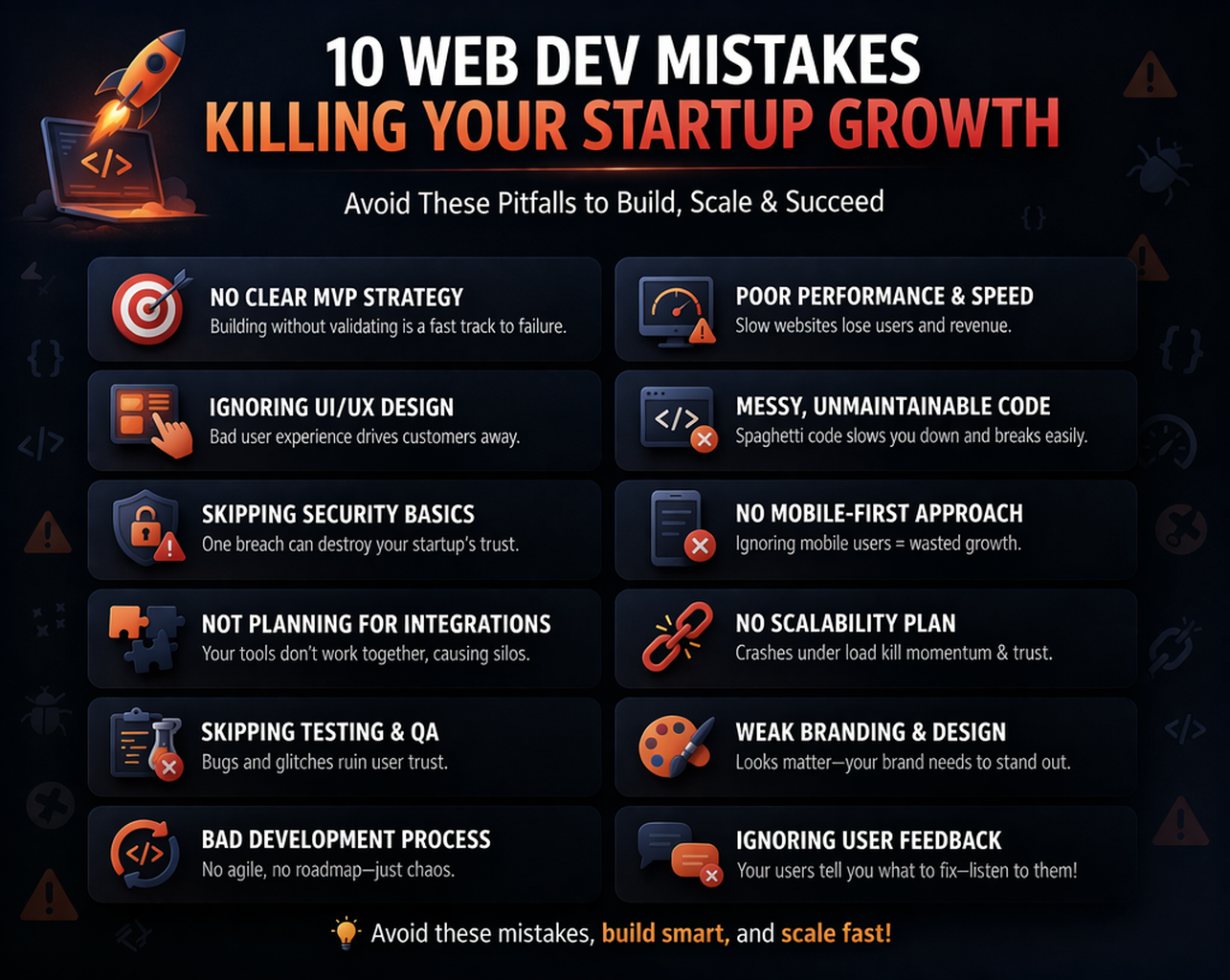
Article gallery
10 Web Dev Mistakes Killing Your Startup Growth visuals from the admin gallery
Need this done properly
Build, performance, SEO, and content can be handled in one delivery flow.
If you are planning a business site, technical blog, or product build that needs to look sharp and rank cleanly, the same approach can be applied to your stack.