


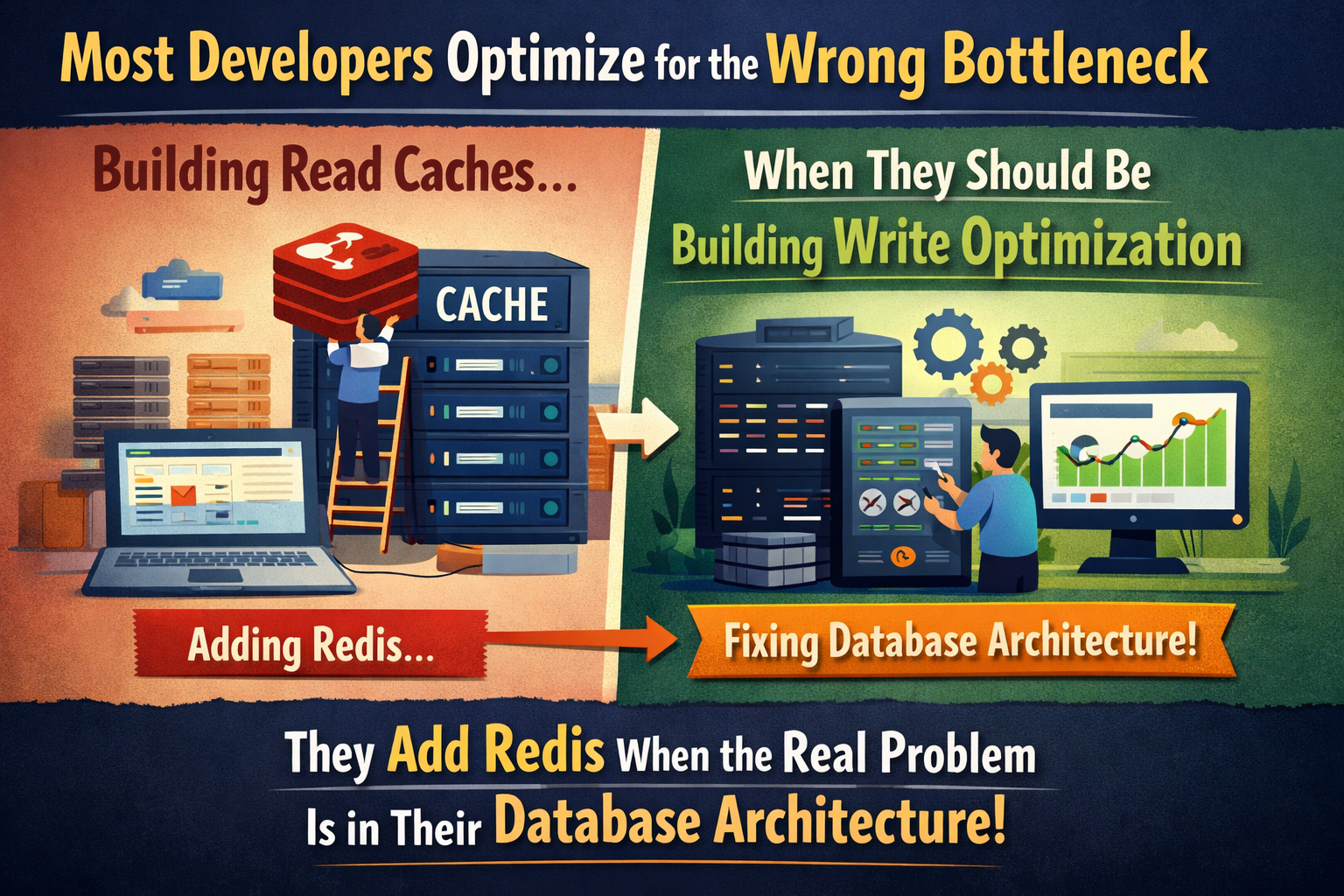
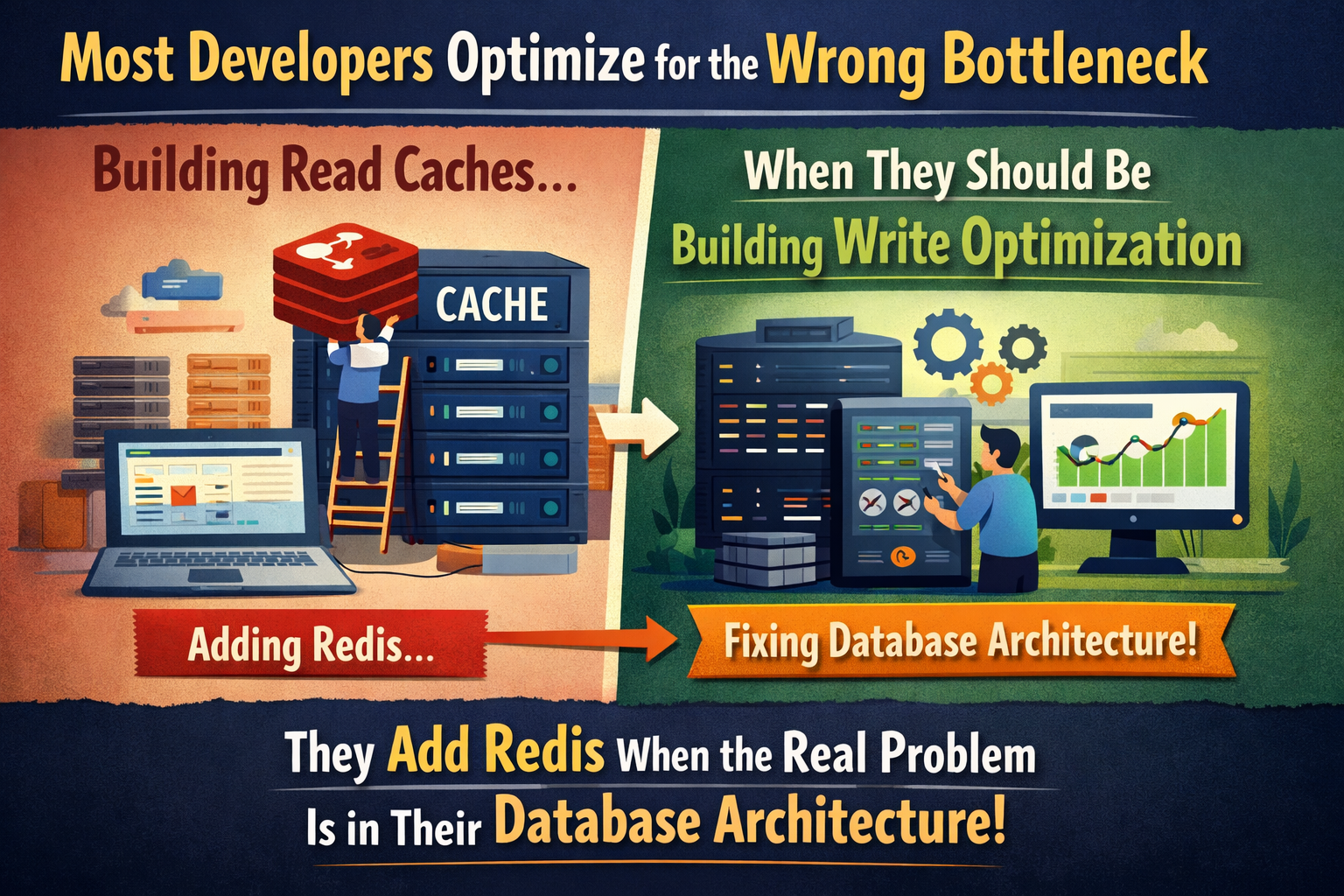
Most Developers Optimize for the Wrong Bottleneck.
Developers often jump to caching solutions like Redis without addressing the real issue—inefficient database architecture. Here’s why optimizing writes and fixing your data model matters more than adding another layer.
Structured like an editorial page, with a cleaner reading flow instead of repeated card blocks.
There’s a pattern I keep seeing again and again.
System slows down → Developer adds Redis → Performance improves slightly → Complexity increases → Problem still exists.
And the cycle continues.
Article gallery
Most Developers Optimize for the Wrong Bottleneck. visuals from the admin gallery
🚨 The Illusion of Optimization
Caching feels like progress.
- Faster responses
- Lower database load
- Quick wins
But most of the time, it’s just a band-aid.
You’re not fixing the system. You’re hiding its weaknesses.
🧠 Where the Real Problem Lives
In many systems, the real bottleneck is not reads — it’s writes.
Think about it:
- Slow inserts
- Lock contention
- Inefficient indexing
- Poor schema design
- Heavy transactions
If your write path is broken, everything else eventually breaks too.
⚡ Why Developers Default to Caching
Because it’s easier.
- You don’t need to rethink architecture
- You don’t need to touch complex database logic
- You get instant (but temporary) results
But this shortcut comes at a cost.
🔍 The Hidden Cost of Premature Caching
- Data inconsistency issues
- Cache invalidation complexity
- Increased infrastructure overhead
- Debugging nightmares
Now instead of one problem, you have three.
🏗️ What Should Be Done Instead
1. Fix Your Database Architecture
- Design schema based on real use cases
- Avoid unnecessary joins or over-normalization
- Choose the right storage engine
2. Optimize the Write Path
- Batch writes where possible
- Reduce lock contention
- Use proper indexing strategy
- Consider event-driven or async processing
3. Measure Before You Optimize
- Use profiling tools
- Identify actual bottlenecks
- Don’t guess — verify
4. Add Caching Later, Not First
Caching should enhance a healthy system, not compensate for a broken one.
🚀 When Redis Actually Makes Sense
Redis is incredibly powerful — when used correctly.
Use it when:
- Your reads are truly the bottleneck
- You’ve already optimized your database
- You need ultra-low latency at scale
Otherwise, you're just adding complexity without solving the root issue.
🎯 The Real Shift
Stop thinking:
“Let’s make reads faster.”
Start thinking:
“Why are writes slow in the first place?”
🔥 Final Thought
Great systems are built by fixing the foundation, not layering over problems.
Because in the long run:
Architecture beats hacks. Every time.
👉 Optimize what matters. Not what’s easy.
Need this done properly
Build, performance, SEO, and content can be handled in one delivery flow.
If you are planning a business site, technical blog, or product build that needs to look sharp and rank cleanly, the same approach can be applied to your stack.